Just a brief note. The Supreme Court agreed with my post from a few months ago and will allow pharmaceutical companies to purchase data on physician drug prescribing practice. The vote was 6-3; Sonia Sotomayor joined Anthony Kennedy and the four pro-business conservatives.
I think having more of this data collected in a standard way will be good - and eventually will help us improve prescription practices. I'd like to see this data available in patient-friendly ways.
In an era of high patient cost-sharing, patients will start wanting to know if their doctor is making cost-effective prescription choices.
Massachusetts Attorney General Reports on Health Care Costs
 6:18 AM
 indigo
Today’s Managing Health Care Costs Indicator is 10%
Martha Coakley, the Massachusetts Attorney General, just released her 2011 report on health care in the Commonwealth.
The AG’s office delivered civil investigative demands, the equivalent of a subpoena, to three major health plans and 16 different provider organizations. They then reviewed payment rates among the plans and providers, and incorporated health plan risk adjustment in their analyses. They also reviewed available quality data – which showed little correlation with cost.
There are 55 pages of gems here – and I’ll talk about the relation of wealth and health care costs in a future post.
The news reports I’ve heard so far have concentrated on disparities of provider payments – with some providers getting payments as much as twice as high as others. The AG’s office concludes that addressing price inequities was a prerequisite to lowering the cost of health care, and that moving to global or bundled payments alone will not solve our health care cost crisis.
I’m still digesting this document. Here’s a link to the Boston Globe report in today’s paper.
I’d like to highlight a few of the report’s conclusions today.
1. There is substantial disparity in total medical expenditure, risk adjusted, from provider group to provider group. Here's an example from the AG report:

2. The Children's Hospital provider organization is high cost in all three health plans, and there are a few other providers which appear in the top five most expensive in all three health plans. However, there is a huge amount of scatter in which groups get paid more and which get paid less. Market clout is similar for provider groups with each payer – so it’s surprising to see such widespread differences. Here are the three relevant graphs - double click on each one to enlarge.


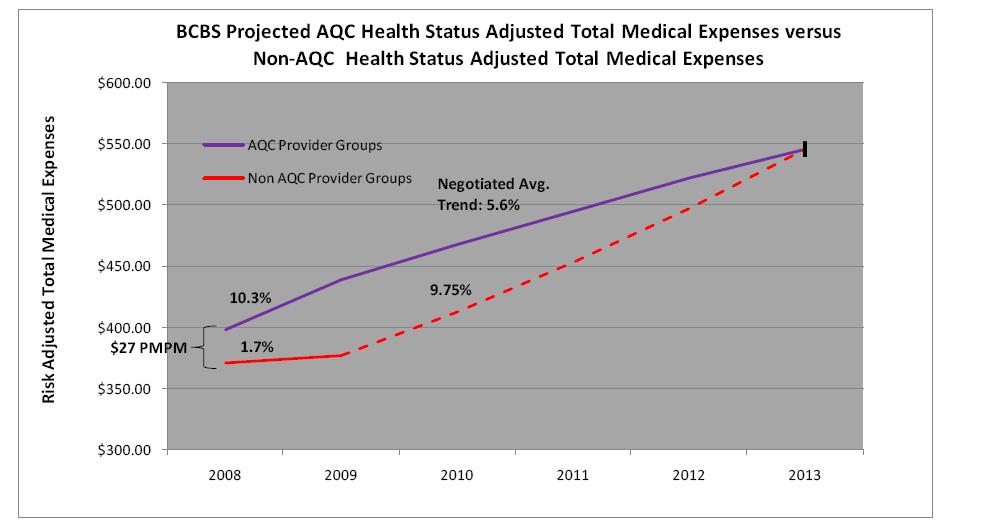
3. The BCBSMA Alternative Quality Contract, which includes a global budget, appears to increase the short-term total medical expenditure. The non-AQC groups, which include Partners HealthCare, have lower costs in the first place and a lower trend rate than the AQC groups. The annual trend during 2009, the first year of the AQC, the trend for the nonAQC groups was 1.7%, while the trend for the AQC groups was 10%. It’s striking that BCBSMA projects that the costs per member per month for the AQC groups will converge with the nonAQC groups in 2013 – and that costs which are now ~$375- $400 pmpm will be just under $550 pmpm
I’ll have more thoughts on this report in the coming days.
The Tragedy of Underfunded Mental Health Care
7:04 PM
indigo
Today’s Managing Health Care Costs Indicator is 19,900
The NY Times on Friday had a deeply disturbing article on a murder that stunned the mental health community here in Massachusetts. A long-term schizophrenic man, off his medicine and spiraling into incoherence, killed a young female counselor who was the sole worker at a group home in a Boston suburb.
His mother, who works at a Boston teaching hospital, was frantic with worry as her adult son, who had been arrested for assault multiple times, was becoming more psychotic. It was hard for her to get anyone’s attention.
The counselor was the first in her family to get a college degree, and had just decided to go to nursing school. Now she’s dead – and her family had trouble scraping together the resources for a burial. The schizophrenic will be imprisoned for the rest of his life – which ironically could be the best chance for him to get appropriate medical care.
Both families are thrown in to turmoil – many lives have been inexorably altered. How did we get here?
The Massachusetts Department of Mental Health is responsible for 19,900 people with severe and persistent mental illness. Massachusetts has closed 20,000 inpatient mental health beds over the last decades, and the state is debating closing a quarter of the remaining 626 long-term mental health beds. Hospitals that offer inpatient mental health services are struggling to survive – and patients who need inpatient mental health admissions can languish in Emergency Departments while psychiatrists scurry to find scarce placements.
It’s just as bad on the outpatient side. Very few child psychiatrists, in short supply, take any kind of private insurance, and waiting lists are long. Adult mental health services have diminished, and psychiatrists have largely transitioned to medication management, leaving cognitive therapy to nonphysicians. Health plans have historically done aggressive utilization review on mental health services, so that patients are discharged from outpatient or inpatient therapy more quickly – and it’s hard to get back into the system with a relapse. With major psychiatric disease, relapses are common.
It’s much better in Massachusetts than elsewhere in the country, where the budget crisis has hit harder, and where few politicians will advocate for the mentally ill. After Jared Loughner killed 6 and wounded 13 including Congressman Gabrielle Giffords in January, there were a series of articles about mental health cuts in Arizona and elsewhere in the country. But that attention didn’t last.
When we underfund mental health care, we bear the costs outside of the medical budget.
Families bear the majority of these costs; parents leave their jobs to watch their deeply ill children even as they reach adulthood, and spouses struggle to be case managers for their loved ones.
We send many of those with severe mental illness to jail – at a very high cost. In Massachusetts, a quarter of the prison population now requires mental health services, up by 2/3 since 1998.
Employers bear some cost, as well, with lost productivity from those with mental illness, as well as from family members who are struggling to themselves compensate for the failings of our system.
Managed behavioral health care has been wildly successful, though. While the cost of most medical services has burgeoned, the cost of professional services for those with mental illness has been pretty much flat. The cost of hospitalization has shrunken dramatically, and we’re severely underfunding outpatient mental health services.
Those with mental health needs have dramatically higher overall medical expenses – and are more frequently readmitted to the hospital.
The only place we’re spending more money on mental health services is in pharmaceuticals, which rose from 7% of total mental health spending (1986) to 27% of spending (2005). Mental health drugs represent a third of total Medicaid drug spending in many states. More irony – many of the newer antipsychotics that replaced inexpensive generic medications appear to be no better!
I often argue for decreased spending in many areas of health care. I think there is opportunity to lower the cost of pharmacotherapy in mental health, too. But it feels like we’ve gone too far in trying to lower professional and inpatient behavioral health costs. We’ve transferred these costs from society (largely Medicaid) and risk pools (employers) to prisons and to the individuals and families haunted by mental illness.
There must be a better way.
There must be a better way.
Unnecessary Double Chest CT Scans
3:22 AM
indigo
Today’s Managing Health Care Costs Indicator is 75,000
Saturday’s New York Times had a great example of using variation to identify waste in the health care system
It’s almost never necessary to do two chest CT scans in a single day – one without contrast, the other with contrast. The ordering physician should know in advance whether she is looking for disease that requires imaging of the vasculature system.
It’s bad to do sequential chest CT scans of patients for at least three reasons. Each chest CT scan is the equivalent of 350 chest x-rays – and we should avoid the extra radiation exposure, which does cause some cases of breast and lung cancer. The cost of CT scans is high – CMS reports that these duplicate CT scans cost Medicare alone $25 million. Doing extra tests poses the danger of finding “incidentalomas,” findings that are not relevant to health, but that require additional tests which pose new health risks and additional expenses.
Yet there are some hospitals that do double chest CT scans on almost nine of every ten patients who get a single chest CT. Many hospitals are under 1% - yet the national average is 5.4%.
I encourage you to look at the interactive geographic map showing excess utilization – it shows pockets of overutilization including Texas, Oklahoma, southern California, and the midsection of the country from Illinois to Mississippi.
Fee for service payment is one of the culprits here – hospitals with high rates of repeat chest CT scans make more revenue – and for a high fixed cost item like CT scans, make even more margin on this service. However, there is a straightforward fee for service fix. We should simply bundle together any two chest CT scans done on the same person at the same facility within 48 hours of each other.
By the way, CMS also announced on Friday that it will use predictive modeling to proactively identify fraud in health care bills. CMS until now has paid all submitted bills, and chased any fraudsters retrospectively identified. Many of those billing CMS fraudulently have disappeared long before Medicare could recoup money -- so this could help lower Medicare costs.
These are two good examples of studying variation to improve health care cost-effectiveness.
These are two good examples of studying variation to improve health care cost-effectiveness.

