Showing posts with label Attorney General. Show all posts

Dueling Estimates of Cost Saving From New Massachusetts Blue Cross Global Payment Contract


Today’s Managing Health Care Costs Indicator is $15.51. 
Or Maybe it’s -$70.20


Click to enlarge

The New England Journal of Medicine published an financial assessment of the first year of the Blue Cross Blue Shield of Massachusetts Alternative Quality Contract last night. It’s been making the headlines for showing that groups in this contract, which includes provider responsibility for overall financial costs, had lower overall increase in medical claims spending than groups that were not in this contract.

The headlines have been clear.  “It saves money”  You have to read well into the coverage  to see that this isn’t accurate.

The authors of the NEJM article are very clear that the AQC did not save money in the first year, which is consistent with last month’s report from the Massachusetts Attorney General.  In fact, the authors state:

Total BCBS payments to AQC groups, including bonuses for quality, are likely to have exceeded the estimated savings in year 1.

The combination of bonuses for being below budget (~3%) and bonuses for achieving quality thresholds (3-5%) and extra BCBSMA administrative costs (0-2%) made the AQC groups substantially more expensive than non-AQC groups.  The AG report showed clearly that early adopter AQC groups had surprisingly high total costs in the Blue Cross plan – probably because of these additional expenses.  (The $70.20 above is multiplying the AG medical inflation differential by the calculated quarterly cost from the NEJM article referenced above)

Another surprise is that in the medical claims costs, we aren’t seeing evidence of better quality of care such as fewer admissions or emergency department visits. Utilization changes are not different between AQC and non-AQC groups. Rather, the AQC groups referred patients to less expensive providers – so the lower claims cost was entirely from lower unit costs.   

Note also that the analysis excluded pharmacy. The AQC groups might well have had higher pharmacy costs, since the physicians received bonuses based on hitting some quality measures that require prescription medications.

It’s not a surprise that BCBSMA had to pay a lot to entice groups to join this capitated program – and no one should have expected lower costs in year one .  I’m hopeful that over time this program will yield lower costs – because physicians in a global payment arrangement figure out how to save resources.  

However, the AQC is like many other medical management interventions in that right now BCBSMA can only claim that its AQC has improved quality – not that it has lowered cost.  

Premium Freeze in Massachusetts?


Today’s Managing Health Care Costs Indicator is 0


Health Care for All, an advocacy group that played a substantive role in passing health care reform here in Massachusetts, has come out in favor of a health insurance premium freeze.    They cite the case of Sarah Higginbotham, who says her biweekly take-home pay for a part time job at a church used to be $900, but has dwindled to $164 since she now has a family plan and health insurance premiums have risen by double digits each year.

Premium increases are caused by a combination of increased unit prices, increased utilization, increased intensity of services, and increased burden of illness.  Price increases could be substantially decreased or eliminated quickly, although that might take price controls.   Lifestyle change can lower burden of illness, but not by 2012.  Increased utilization can be changed – but takes some time.  Increased intensity of service sometimes represents innovations that can save lives (such as today's New England Journal, which has an article showing that screening CT scans for those at high risk for lung cancer can save lives. More on that in a future post.)  


Most insurance funded by large insurers is “self insured,” so that the stated premium is irrelevant – as the employer pays the bills.  However, smaller employers need to purchase “fully funded” insurance –so the level of stated premium is the price paid by the employer and employee.   A premium freeze would be a big break for small employers and nonprofits.   But it won’t be easy to achieve, and lower premium increases will only be sustainable with genuine change in the health care delivery system.

Health insurers in Massachusetts could offer a premium freeze on fully-insured health plans by one of the following methods:


Lower Profits:
Some insurers have high profit margins, and could endure a year of a premium freeze just be accepting lower profits.  However, Massachusetts insurers generally have low profit margins.


Lower administrative costs:
Administrative costs for the nonprofit regional health plans here are also on the low side nationally.   Administrative costs represent less than 10% of total premium, and the claims must be paid – so that wouldn’t likely achieve enough savings to allow for a premium freeze.


Lower provider payments The Attorney General’s report documents that some providers receive higher unit payments, and also have higher risk-adjusted total medical expense costs.  However, each health plan would need to reopen negotiations with multiple providers to get lower prices.  The market has determined those prices – so it won’t be easy to change these quickly.  Remember also that we don’t have providers with huge profit margins. So, significant provider pay cuts will likely cause job loss and attempts to cost-shift to payers that have less leverage.


 Lower medical costs Health plans have been performing medical management for years – and these programs can make a difference, especially for high risk patients.  Health management programs aren’t cheap, though, and they take a substantial amount of time to pay off.   I don’t imagine that plans to increase medical management or to improve healthy lifestyles of Massachusetts residents will make huge difference in health care costs in 2012.


Cost-shifting Insurers could raise premiums elsewhere to cover the lost revenue from a premium freeze.  Again, the market wouldn’t make this easy – and some national insurers might leave the state.


Risk-shifting Insurers could avoid insuring the sickest patients – and could therefore avoid premium increases.  However, regulation of the small group market makes it difficult for health plans to selectively enroll healthy patients.

So, I’m not optimistic we’ll achieve a health insurance premium freeze in Massachusetts in 2012.  However, hats off to Health Care for All for humanizing the impact of health care premium increases.   I think this conversation can help push meaningful change in health care delivery that could lower future health care cost increases.

Massachusetts Attorney General Reports on Health Care Costs


Today’s Managing Health Care Costs Indicator is 10%


Martha Coakley, the Massachusetts Attorney General, just released her 2011 report on health care in the Commonwealth.

The AG’s office delivered civil investigative demands, the equivalent of a subpoena, to three major health plans and 16 different provider organizations.  They then reviewed payment rates among the plans and providers, and incorporated health plan risk adjustment in their analyses.  They also reviewed available quality data – which showed little correlation with cost.

There are 55 pages of gems here – and I’ll talk about the relation of wealth and health care costs in a future post. 

The news reports I’ve heard so far have concentrated on disparities of provider payments – with some providers getting payments as much as twice as high as others.  The AG’s office concludes that addressing price inequities was a prerequisite to lowering the cost of health care, and that moving to global or bundled payments alone will not solve our health care cost crisis.

I’m still digesting this document.  Here’s a link to the Boston Globe report  in today’s paper. 

I’d like to highlight a few of the report’s conclusions today.

1. There is substantial disparity in total medical expenditure, risk adjusted, from provider group to provider group. Here's an example from the AG report: 


2. The Children's Hospital provider organization is high cost in all three health plans, and there are a few other providers which appear in the top five most expensive in all three health plans.  However, there is a huge amount of scatter in which groups get paid more and which get paid less.  Market clout is similar for      provider groups with each payer – so it’s surprising to see such widespread differences. Here are the three relevant graphs - double click on each one to enlarge.


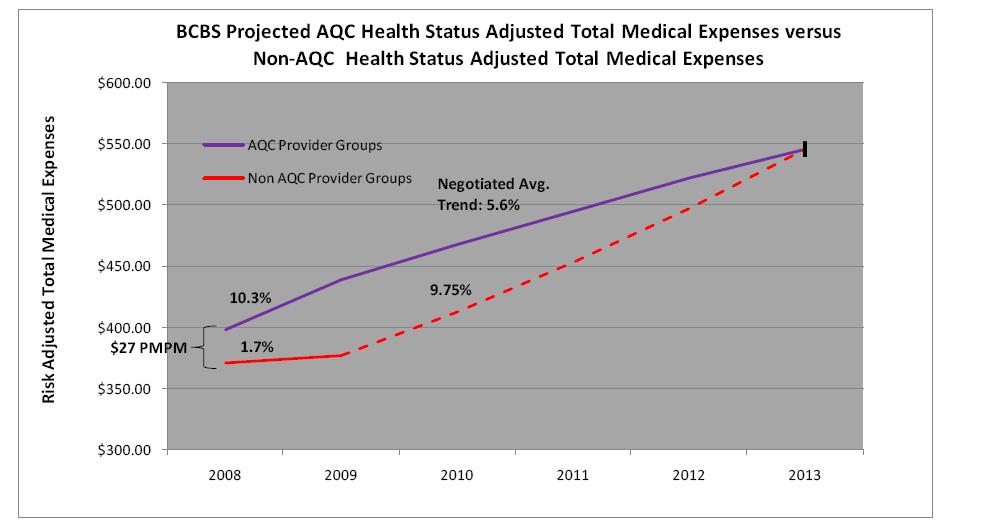
    3. The BCBSMA Alternative Quality Contract, which includes a global budget, appears to increase the short-term total medical expenditure.  The non-AQC groups, which include Partners HealthCare, have lower costs in the first place and a lower trend rate than the AQC groups. The annual trend during 2009, the first year of the AQC, the trend for the nonAQC groups was 1.7%, while the trend for the AQC groups was 10%.  It’s striking that BCBSMA projects that the costs per member per month for the AQC groups will converge with the nonAQC groups in 2013 – and that costs which are now ~$375- $400 pmpm will be just under $550 pmpm


    I’ll have more thoughts on this report in the coming days.

    Unit Cost vs. Utilization As Reason for Health Care Cost Increases

    The Massachusetts Attorney General published a final report about two weeks ago showing the impact of unit price increases compared to utilization increases for the three major regional health plans in Eastern Massachusetts.    As you can see, over recent years the overwhelming reason for increased overall health care costs was increase in unit cost - not increase in utilization.  

    You can click any of these to enlarge - or go to the full report


    Free Host | new york lasik surgery | cpa website design