I'm traveling - so not doing full postings.
A few articles of note
The Boston Globe reports that Harvard Pilgrim has identified which providers are paid the most for different services. This is not risk adjusted - but the differences are far larger than you'd expect to be eliminated by risk adjustment.
The New York Times reports that more physicians are dropping out of Medicaid because of fee cuts. The article also points out how difficult it is to care for Medicaid patients when many cash-strapped states eliminate vital benefits? How do you treat a Medicaid beneficiary with an infected tooth when dental is no longer covered? Not well, obviously.
The LA Times reports that the number of uninsured in California continues to rise rapidly - now approaching a quarter. The issue of how to pay for health care for the uninsured grows larger by the day.
Showing posts with label Medicaid discount. Show all posts
Showing posts with label Medicaid discount. Show all posts
CMS: 2008 Medical Inflation Much Lower
 2:26 PM
 indigo

The Centers for Medicare and Medicaid studies released its report on health care spending in 2008 – published in Health Affairs on Monday and covered extensively in the press. The good news is that health care inflation overall was lower than it’s been for years (4.4%). The bad news is that health care inflation continued to outpace growth in the economy – so health care moved from 15.9% to 16.2% of GDP.
Some of the conclusions that have been widely reported
- Health care is not immune to the effects of severe recessions
- Hospital inflation decreased to 4.5% - and hospital prices only went up 3%
- Physician services increased by 5% - the slowest rate since 1996. Medicare physician spending, however, increased by 7.8%
- Prescription drug spending increased only 3.2% - continuing a trend of relatively low pharmaceutical inflation with the onset of many new generics and without big blockbusters coming out of the pipeline. Still, most of this increase was price (2.5%) as opposed to utilization.
-Medicare spending was up 8.6% - and growth in Medicare Advantage plans played a role. Big cuts in Medicare Advantage reimbursement in health care reform could now have an impact on more constituents.
- Medicaid spending increased.
One observation that has not been covered extensively. The government pays much lower rates (especially Medicaid). Therefore, a shift of a patient from commercial health insurance plans to Medicaid could easily mean a decline of 50% in reimbursement to many hospitals. If providers shift these costs by charging private insurers more, then there are no “real” savings. On the other hand, if providers see decreases in revenue and reengineer their processes to allow for sustainability at lower reimbursement, then the increased government role should lower unit prices.
I’ve often blogged about the problem we have with unit price in the United States

A Public Health Success That Can Save Real Dollars
6:40 PM
indigo
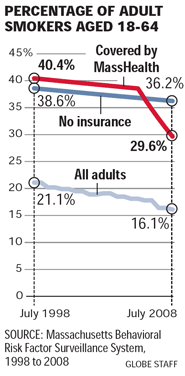
Preliminary data also shows lower rates of heart attacks among those who used the program.
There are reasons to be a bit skeptical of this data. Those who used the smoking cessation program were probably different than those who didn't, and the percent drop seems quite high. Also, Medicaid is a combination of "Temporary Assistance to Needy Families" (largely pregnant women and their kids -where smoking rates do not lead to a lot of heart attacks in the short run), and those with serious disabilities, who are older and where smoking cessation could lead to prevented heart attacks over the short run.
Still - this is just great news. Smoking is a very major cause of preventable illness and death, and smoking rates remain highest among those with lower socioeconomic status. It's unfortunate that even in light of the proven effectiveness of antismoking programs states have cut funding for such programs in light of their current budget shortfalls.
Pay for Performance Comes to Ambulatory Pharmaceuticals
2:57 AM
indigo
The New York Times reports today that two pharmaceutical companies are entering the “pay for performance” market to preserve lower patient copayments for their expensive brand name medicines and maintain or grow market share. This is modeled after a Johnson and Johnson deal with the British NHS to offer refunds for an expensive oncology medicine if it did not shrink an individual patients’ tumor(s). See an earlier blog on how the British comparative effectiveness program led to this discount offer.
Merck will give discounts to the insurer Cigna on its diabetes medicine Januvia (and combination pill Janumet) if Cigna patients in the aggregate have lower blood sugars, and the makers of Actonel, an osteoporosis medication, will give a small insurer cash payments for adherent patients on this medication who have osteoporosis-related fractures. There are alternative far cheaper generic medications that can readily substitute for Actonel and Januvia/Janumet.
The Times does not mention that drug companies are subject to a “most favored nation” clause which guarantees Medicaid programs the lowest price – so that any price concession to even a small insurer can lead to large rebate checks for every state Medicaid programs. In general (and counterintuitively), this most favored nation arrangement keeps prices unnecessarily high – since it enforces price discipline among the pharmaceutical companies. My sense is that a refund for nonperformance would not “count” as a discount, and therefore this approach allows the pharmas to offer lower rates to the most price-sensitive health plans without jeopardizing Medicaid rates.
On one hand, this is a good move. Pharmaceutical companies are selling a result (lower blood sugars and fewer nonspine fractures) rather than selling a pill.
Will this lead to lower health care costs? My guess is “no,” since these are very expensive drugs, and even discounts or refunds are not likely to bring them down to the true cost of generic alternatives. There is a better argument that Januvia represents a real advance over other oral diabetes medicines. However, I doubt that the incremental value of Januvia, even with the discounts Cigna will obtain, will be cost-saving, as opposed to cost-effective. This also leads to some opacity in the pharmaceutical market, which will allow for more price discrimination and likely yield higher pharma margins. Even if this yields higher overall costs and higher pharma margins, though, it might lead to increased value in the health care delivery system.
Merck will give discounts to the insurer Cigna on its diabetes medicine Januvia (and combination pill Janumet) if Cigna patients in the aggregate have lower blood sugars, and the makers of Actonel, an osteoporosis medication, will give a small insurer cash payments for adherent patients on this medication who have osteoporosis-related fractures. There are alternative far cheaper generic medications that can readily substitute for Actonel and Januvia/Janumet.
The Times does not mention that drug companies are subject to a “most favored nation” clause which guarantees Medicaid programs the lowest price – so that any price concession to even a small insurer can lead to large rebate checks for every state Medicaid programs. In general (and counterintuitively), this most favored nation arrangement keeps prices unnecessarily high – since it enforces price discipline among the pharmaceutical companies. My sense is that a refund for nonperformance would not “count” as a discount, and therefore this approach allows the pharmas to offer lower rates to the most price-sensitive health plans without jeopardizing Medicaid rates.
On one hand, this is a good move. Pharmaceutical companies are selling a result (lower blood sugars and fewer nonspine fractures) rather than selling a pill.
Will this lead to lower health care costs? My guess is “no,” since these are very expensive drugs, and even discounts or refunds are not likely to bring them down to the true cost of generic alternatives. There is a better argument that Januvia represents a real advance over other oral diabetes medicines. However, I doubt that the incremental value of Januvia, even with the discounts Cigna will obtain, will be cost-saving, as opposed to cost-effective. This also leads to some opacity in the pharmaceutical market, which will allow for more price discrimination and likely yield higher pharma margins. Even if this yields higher overall costs and higher pharma margins, though, it might lead to increased value in the health care delivery system.

