Showing posts with label Center for Study of Health System Change. Show all posts

Variation: Study Suggests Cost Based on Illness More than Delivery System


Today’s Managing Health Care Costs Quote:

“Insurance is expensive because it's paying for medical care, and it won't be affordable unless the medical care it's paying for becomes affordable.”
Ezra Klein  , January 28, 2011


There’s another volley in the ongoing academic food fight about how much provider variation affects variation in health care costs, and how much of variation is about how sick patients are.

The Center for the Study of Health System Change  has just circularized an article published last week in Health Services Research  which looked at a year of claims data from 1.6 million Medicare beneficiaries in communities where the Community Tracking Survey collected independent information about providers.  High cost beneficiaries cost $48,000, while low cost beneficiaries (top and bottom quintile) cost $7000. 

The high cost beneficiaries were older, more likely to be eligible for both Medicare and Medicaid, and had more diseases.    They were more likely to get health care in multiple census districts, and more likely to have a specialist as their usual source of care.  However, they were not more likely to live in areas with higher hospital, physician or specialist supply.

This is a complicated study of Medicare beneficiaries only, and includes scads of statistical manipulation and adjustments.  It’s not proof that supply has no impact on resource cost. However, I believe this is another indication that we can’t expect to solve the health care cost crisis by profiling providers and controlling capital expense alone. 

We’ll need to make real and difficult change in the actual delivery of care to genuinely sick people to get the cost savings we need.    
Provider Clout

There have been a few excellent articles and studies on provider consolidation – and how much this impacts the overall costs of health care costs.

Kaiser Health News and NPR aired a 7 minute piece on Saturday demonstrating the impact of Sutter Health System in northern California.  It’s almost impossible for major insurance companies to sell policies for products that don’t include Sutter, which receives reimbursement that is now 37% higher than other providers in the area.   Sutter has a profit margin of over 17% - far out of line with most profit or nonprofit hospital systems across the country.  An insurance broker demonstrated that a small business with 20 employees could save $120,000 per year by purchasing health insurance that did not include Sutter.  But he can find few takers for this type of limited network.
Click to enlarge image


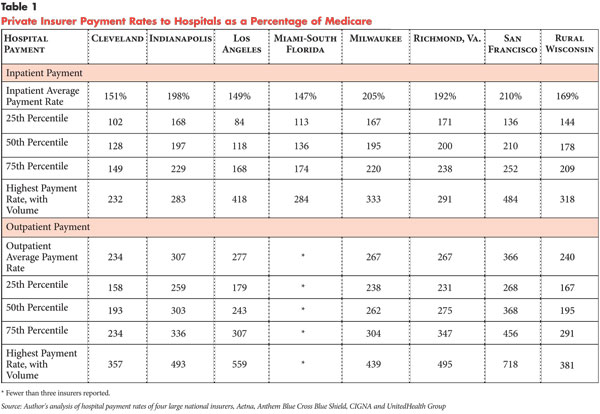
The Center for the Study of Health System Change published a study of 8 markets (including northern and southern California) showing that four large national health insurers pay hugely variable amounts for the health care they provide to their members.  In Los Angeles, the average commercial (employer-sponsored) health plan pays 118% of Medicare for inpatient care.  However, the 25%ile hospital receives 84% of Medicare payment, the 75%ile hospital receives 168% of Medicare, and the highest paid hospital receives over four times Medicare payment. 


The Boston Globe  noted last week that Massachusetts Attorney General Martha Coakley has promised to revisit the issue of provider market clout, worrying that proposed payment reform is not enough.  However, as the Center for Health System Change noted, once there are widely different allowed charges among facilities, it will be very hard indeed to roll these back.

The New York Times published an article today noting increasing consolidation of hospitals, ambulatory care centers and physicians.  The article outlines the fear that as providers establish accountable care organizations to service Medicare under health care reform, their influence will grow even larger, as will their ability to extract high prices.


Click to enlarge image

OK – that’s the doom and gloom.  In our class last week, we saw a graphic showing that hospitals have MUCH less consolidation (at least according the US census bureau) than health insurers.  Physicians have less consolidation than just about everyone except for florists.  So- this means there is no problem, right?

Wrong!

Health care delivery is hyperlocal.    Sutter has very high prices and very high margins, and Sutter has high market penetration and importance in its limited geography. It doesn't matter that Sutter provides under 1% of all health care delivery in the US, while  United HealthCare is responsible for insuring 70 million Americans.  In Northern California, Sutter has far greater dominance than any health plan, and is able to use that to drive very high prices.  Limited or tiered networks can exert at least some downward pressure on these prices. 

 
Free Host | new york lasik surgery | cpa website design