Showing posts with label Massachusetts. Show all posts

Day Six of Good News: Massachusetts


Today’s Managing Health Care Costs Indicator is 2%


If you watch the Republican Presidential debates, you’d guess that the health care system in Massachusetts was in utter disarray.   Mitt Romney at least intermittently runs away from what’s probably the signature effort of his one-term governorship, and Newt Gingrich and others rarely go a day without throwing mud and bombs.

Here in Massachusetts, things are… much better than you might think.
  • Our rate of uninsured is about 2% - the lowest in the nation
  • Our current rate of health care cost inflation is no longer the highest in the nation, although it’s still far too high
  • There has been a dramatic move toward contracts that include global payments, which will likely mean that providers will play an important role in modulating future health care cost increases
  • The Attorney General has published meaningful cost data that has been risk adjusted.
  • The state just renegotiated its Medicaid waiver, allowing continued funding for subsidies for health care coverage for the poor and near poor.


Massachusetts’ health care reform was clearly a model for the Affordable Care Act. It’s working well here –which augers well for the future of health care in the US.

I wish all a Happy New Year –and I’ll have some 2011 wrapup and health care innovations that could lower cost from my HSPH fall course “Managing Health Care Costs” over the next week.


The Stakeholders Would Just Plotz!


There’s been some jubiliation in Massachusetts with the Commonwealth Fund report that insurance here is no longer the most expensive in the country.  My colleague Nancy Turnbull, has a great post in the Commonhealth Blog entitled “Stop Kvelling, We Still Need Aggressive Action To Halt Rising Premiums.”  She points out that any jubilation is misplaced – our health care premiums have gone up rapidly – just not as rapidly as a handful of other states.  In fact, by many measures our health insurance remains the most expensive in the country – which means the most expensive on the planet.  

The problem, of course, is that halting the rise of health care premiums will create hardship in the state’s growth industry – health care.  In fact, most of the proposals to lower health care costs make the stakeholders want to plotz!

The commentary is great - and it’s topped off by a prolonged metaphor that left me chuckling. Nancy’s response to a question about why politicians don’t address the impact of rising  health care costs on small business:

There's clearly a great fear of "killing the golden goose" of health care in Massachusetts.  The problem is that the golden eggs are not distributed fairly although we're all paying for the feed, and the price of over-feeding the goose is a starvation diet for  others (including public health).  Sort of like the health care equivalent of foie gras.


(Kvell is a great Yiddish word that means something approaching gloating –but it’s virtuous. We kvell when our kids make deans list.  Plotz is to be so annoyed that you could faint with anger.  When someone threatens to take away what’s mine, I could just plotz.

Three Graphs Tell the Story: It's the Prices!

These three graphs are from the Recommendations of the Massachusetts Special Commission on Provider Price Reform. released last week.  For anyone who wonders if unit cost is a substantial portion of the cause of health care cost increase in Massachusetts, these data paint a clear picture.

The entire report can be accessed at this link.


Click on any image to enlarge it.


Jon Kingsdale, the founding Executive Director of the Connector Authority in Massachusetts, will be talking about the role of government in health care costs in our HSPH course on Wednesday.  Here's a link to a Health Affairs blog post of his from July on the problem of "costitis."

Physician Group Lowers Cost While Improving Quality


Today’s Managing Health Care Cost Indicator is $16,000

Click image to enlarge.  Source

November’s Atlantic Monthly profiles Caremore, the California-based physician practice purchased this spring for $800 million by Wellpoint, the nation’s largest health insurance plan.  The practice cares for about 50,000 Medicare beneficiaries, and is paid through capitation via the Medicare Advantage (Part C) program.

The practice is about 20 years old, and has an impressive record of improving care while lowering overall costs.  Much of what the practice does is invest in improved care – by paying for taxi rides, doing home visits to assess risks of falls, seeing diabetics with small foot injuries every few days, and electronic monitoring of those at risk for hospitalization from congestive heart failure.

The article is heartening – the practice appears to be doing well by doing good.  These techniques have been used by groups paid capitation by Medicare for years – I remember our group in Cambridge setting up home physical therapy visits to do assessment for fall risks in the early 1990s.   Wellpoint’s purchase of this group (at an eye-popping $16,000 per patient) is market validation that this model works to improve quality and lower cost for the elderly.  Some of these lessons are applicable to those under 65, although there are far fewer very sick people in the younger population who would benefit from many of these approaches.  For instance, 30 day hospital readmission rates are 20% in the Medicare population, but only 9% for a privately insured younger population.  Remember that many of these readmissions are for planned chemotherapy or staged surgery, too.

This provides a good example that providers given a budget can manage to make health care more affordable.   That’s good news for policymakers in Massachusetts, who are pushing toward legislation to expand global payment to control health care costs.  However, expanding this approach from a niche group of providers to an entire state will be no small challenge.

Dueling Estimates of Cost Saving From New Massachusetts Blue Cross Global Payment Contract


Today’s Managing Health Care Costs Indicator is $15.51. 
Or Maybe it’s -$70.20


Click to enlarge

The New England Journal of Medicine published an financial assessment of the first year of the Blue Cross Blue Shield of Massachusetts Alternative Quality Contract last night. It’s been making the headlines for showing that groups in this contract, which includes provider responsibility for overall financial costs, had lower overall increase in medical claims spending than groups that were not in this contract.

The headlines have been clear.  “It saves money”  You have to read well into the coverage  to see that this isn’t accurate.

The authors of the NEJM article are very clear that the AQC did not save money in the first year, which is consistent with last month’s report from the Massachusetts Attorney General.  In fact, the authors state:

Total BCBS payments to AQC groups, including bonuses for quality, are likely to have exceeded the estimated savings in year 1.

The combination of bonuses for being below budget (~3%) and bonuses for achieving quality thresholds (3-5%) and extra BCBSMA administrative costs (0-2%) made the AQC groups substantially more expensive than non-AQC groups.  The AG report showed clearly that early adopter AQC groups had surprisingly high total costs in the Blue Cross plan – probably because of these additional expenses.  (The $70.20 above is multiplying the AG medical inflation differential by the calculated quarterly cost from the NEJM article referenced above)

Another surprise is that in the medical claims costs, we aren’t seeing evidence of better quality of care such as fewer admissions or emergency department visits. Utilization changes are not different between AQC and non-AQC groups. Rather, the AQC groups referred patients to less expensive providers – so the lower claims cost was entirely from lower unit costs.   

Note also that the analysis excluded pharmacy. The AQC groups might well have had higher pharmacy costs, since the physicians received bonuses based on hitting some quality measures that require prescription medications.

It’s not a surprise that BCBSMA had to pay a lot to entice groups to join this capitated program – and no one should have expected lower costs in year one .  I’m hopeful that over time this program will yield lower costs – because physicians in a global payment arrangement figure out how to save resources.  

However, the AQC is like many other medical management interventions in that right now BCBSMA can only claim that its AQC has improved quality – not that it has lowered cost.  

Premium Freeze in Massachusetts?


Today’s Managing Health Care Costs Indicator is 0


Health Care for All, an advocacy group that played a substantive role in passing health care reform here in Massachusetts, has come out in favor of a health insurance premium freeze.    They cite the case of Sarah Higginbotham, who says her biweekly take-home pay for a part time job at a church used to be $900, but has dwindled to $164 since she now has a family plan and health insurance premiums have risen by double digits each year.

Premium increases are caused by a combination of increased unit prices, increased utilization, increased intensity of services, and increased burden of illness.  Price increases could be substantially decreased or eliminated quickly, although that might take price controls.   Lifestyle change can lower burden of illness, but not by 2012.  Increased utilization can be changed – but takes some time.  Increased intensity of service sometimes represents innovations that can save lives (such as today's New England Journal, which has an article showing that screening CT scans for those at high risk for lung cancer can save lives. More on that in a future post.)  


Most insurance funded by large insurers is “self insured,” so that the stated premium is irrelevant – as the employer pays the bills.  However, smaller employers need to purchase “fully funded” insurance –so the level of stated premium is the price paid by the employer and employee.   A premium freeze would be a big break for small employers and nonprofits.   But it won’t be easy to achieve, and lower premium increases will only be sustainable with genuine change in the health care delivery system.

Health insurers in Massachusetts could offer a premium freeze on fully-insured health plans by one of the following methods:


Lower Profits:
Some insurers have high profit margins, and could endure a year of a premium freeze just be accepting lower profits.  However, Massachusetts insurers generally have low profit margins.


Lower administrative costs:
Administrative costs for the nonprofit regional health plans here are also on the low side nationally.   Administrative costs represent less than 10% of total premium, and the claims must be paid – so that wouldn’t likely achieve enough savings to allow for a premium freeze.


Lower provider payments The Attorney General’s report documents that some providers receive higher unit payments, and also have higher risk-adjusted total medical expense costs.  However, each health plan would need to reopen negotiations with multiple providers to get lower prices.  The market has determined those prices – so it won’t be easy to change these quickly.  Remember also that we don’t have providers with huge profit margins. So, significant provider pay cuts will likely cause job loss and attempts to cost-shift to payers that have less leverage.


 Lower medical costs Health plans have been performing medical management for years – and these programs can make a difference, especially for high risk patients.  Health management programs aren’t cheap, though, and they take a substantial amount of time to pay off.   I don’t imagine that plans to increase medical management or to improve healthy lifestyles of Massachusetts residents will make huge difference in health care costs in 2012.


Cost-shifting Insurers could raise premiums elsewhere to cover the lost revenue from a premium freeze.  Again, the market wouldn’t make this easy – and some national insurers might leave the state.


Risk-shifting Insurers could avoid insuring the sickest patients – and could therefore avoid premium increases.  However, regulation of the small group market makes it difficult for health plans to selectively enroll healthy patients.

So, I’m not optimistic we’ll achieve a health insurance premium freeze in Massachusetts in 2012.  However, hats off to Health Care for All for humanizing the impact of health care premium increases.   I think this conversation can help push meaningful change in health care delivery that could lower future health care cost increases.

RomneyCare Works.


Today’s Managing Health Care Costs Indicator is 98.1%

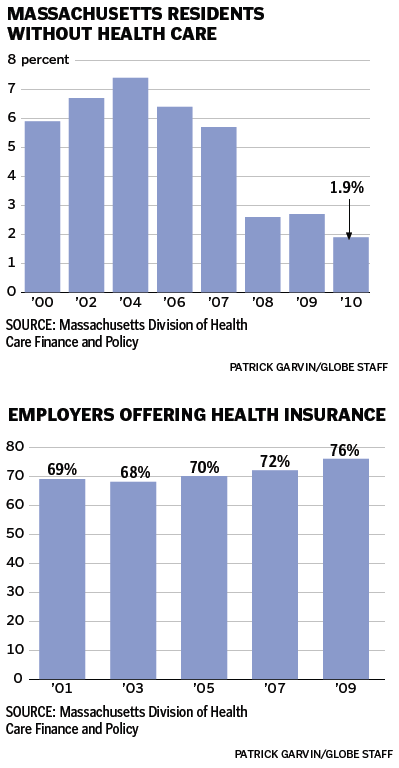
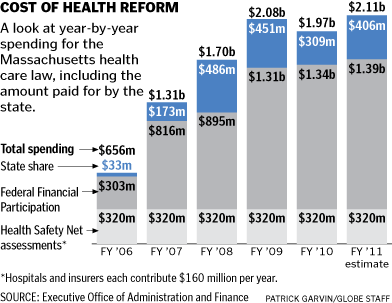
Click to enlarge image
There has been a lot in the national press about how health care reform in Massachusetts has worked.  There's a lot of blather on both sides of the political spectrum, and the Boston Globe had a comprehensive article today reviewing how “RomneyCare” is working here. 

Conclusions:

1) Far more people are insured than before health care reform, despite the disastrous recession (98.1%)
2) More employers (up from 70 to 76%) are offering insurance, again despite the recession
3) The exchanges work for individuals - they haven't worked well for small employers yet
4) The cost of the care of the uninsured has declined.
5) There is inadequate primary care access, and ED visits have gone up rather than down.
6) The cost has been manageable - but the state has relied on some payments from the feds (stimulus dollars and Medicaid add-on dollars) that will not continue. The federal government has paid a disproportionate share of the total cost (as it will under the Affordable Care Act).
7) Health care reform promised incremental provider Medicaid payments that have not been funded. Hospitals say they must pass these costs on to other payers, which worries employers greatly.
8) Health care reform is actually pretty popular in Massachusetts.  The last Harvard School of Public Health poll said that 63% of residents support health care reform. 


Massachusetts’ Health Care Reform: Chapter 2


Today’s Managing Health Care Costs Indicator is 52

  
Governor Deval Patrick of Massachusetts announced the state’s plans to move from fee for service to bundled payments for accountable care organizations (ACOs) last week.   The initiative could be a bold reshaping of health care in the Commonwealth It could be the opening volley in a battle to reintroduce rate regulation.  Or it could be an interesting idea that doesn’t make any legislative headway. 

Here’s my outline of the 52 page proposed legislation: 

·      * The Attorney General is instructed to:
o   Evaluate potential provider mergers and accountable care organizations (ACOs) to be sure these are not anticompetitive
o   Help arrange necessary federal waivers
o   Develop an enforcement mechanism to prohibit providers from shifting costs from one payer to another.
·      * The Division of Insurance will
o   Collect data on provider contracts and determine if they are consistent with legislation, including increases below certain thresholds.
o   Disapprove rate hikes that are based on provider contracts inconsistent with this legislation
·      * The Executive Office of Health and Human Services will
o   Help arrange necessary waivers
o   Establish an ACO pilot with early-adopter provider organizations
o   Report on progress
·      * The Division of Health Care Finance and Policy (DHCFP) gets substantial new responsibilities:
o   Evaluate alternative payment methods
o   Determine how to share reporting on payments with the public
o   Examine terms of health plan contracts with providers, and require annual reporting on these, including an inventory of payment methods to be completed by March, 2012
o   Figure out how to apply the state’s preferred payment methodology to self-funded employers
o   Study best practices from other states and other countries
·      * Establishes a Health System and Payment Reform Coordinating Council with responsibilities including:
o   Collects data and report on quality and cost
o   Determines what entities qualify as an ACO
o   Monitors and reports on ACO performance
·      *Establishes a Health Care Information Technology Council and a Behavioral Health Task Force
·      *Mandates that primary care physicians participate in only a single ACO
·      *Establishes a mandatory self-funding reinsurance plan for ACOs 
·      *Standardizes and enforcesuniform risk adjustment so that ACOs and health plans will not “win” by failing to serve those with serious illness.
o   Risk adjustment is supposed to include socioeconomic status, which is notoriously difficult
·      *Malpractice reforms include
o   “Cooling off” period before malpractice claims can be filed, to allow for settlement talks.
o   Disallows apologies from being used against providers in malpractice claims.
o   Protects peer review privilege within ACOs


This is a big bill – and will be changed significantly as it winds its way through the legislative process.

Here are some key observations about factors which will determine this bill’s success.

  •  There are many new responsibilities, especially for DHCFP.   Will there be staff to complete these requirements? Will there be adequate budget to hire independent actuaries and analysts for what the department cannot do within its own staff?
  • Providers and health plans feel proprietary about their contractual arrangements, and have spent years developing the expertise to maximize returns.  The contracts are complex and often not easily comparable
  • It isn’t easy to compare provider prices
    • It’s easiest to compare cost using relative discount rates.  But the ‘chargemaster’ used by most providers is hopelessly irrational.
    • It’s also possible to compare charges for high volume units of service (such as medium intensity office visits.) 
    • However, it’s more appropriate to compare the cost of risk-adjusted episodes of care, so that the provider who uses more units of service doesn’t inappropriately appear to be offering a better “deal.” 
    • Risk adjusting episodes of care is doable- but it’s not for the faint of heart.
  •  The current bill appears to target rate of increase, which would not address existing disparities in allowable fee schedules.
  • A substantial portion of Massachusetts residents get coverage through ERISA eligible plans, where an employer self-funds the health insurance benefit.  These plans are not subject to Massachusetts regulations.   If these plans continue to be fully committed to fee for service, it might be hard to get traction with the provider community
    • On the other hand, Patrick has announced that he expects full participation of 1.7 million beneficiaries who have state-funded health care (state employees, many municipal employees, and Medicaid recipients).


This proposed legislation is ambitious and groundbreaking – a fitting followup to the health care reform that has led to insurance coverage for 98% of Massachusetts residents. 

Mass Cities and Towns Drowning in Future Health Care Liabilities for Retirees


Today’s Managing Health Care Costs Indicator is $18.7 billion


The Massachusetts Taxpayer’s Organization  released a report today documenting the future retiree health care liability for the 50 largest cities and towns in the Commonwealth.

It’s a depressing read.

Boston has underfunded its future retiree health care liability by over $4.5 billion – and to catch up through tax increases, each Boston household would have to pay almost $100,000 more in taxes over the next 30 years.   The current underfunding represents a liability of $10,000 for every Boston resident.

We’re finding out about this because of a new regulation, GASB 45 (Government Accounting Standards Board), which forces municipalities to calculate and disclose their future liabilities for retiree health care.  This is much like the FASB 106 – the 1990 regulation (by the financial accounting standard board) which required publicly traded companies to treat post-retirement health care costs as deferred compensation, which must be recognized when the obligation is incurred.   FASB 106 led to most employers moving away from generous post-retirement health benefits – as GASB 45 is likely to do with state and local governments.

The Mass Taxpayer Organization suggests that cities and towns:
·        Raise retirement ages
·        Raise service length for post-retiree health care coverage
·        Raise cost-sharing in post-retiree programs
·        Insist that eligible retirees transfer their primary insurance to Medicare
·        Not offer coverage for spouses of retirees

A number of cities and towns did not pay into the Medicare Trust Fund prior to 1984, so retirees from before that time are not eligible for Medicare.

All these approaches decrease coverage for government retirees – and many will need to be phased in over years or even decades.   The state has imposed many onerous requirements on cities and towns – historically municipalities have had little freedom to negotiate cost sharing. On the other hand, many have offered benefits even more generous than the generous benefits required by the state.

One suggestion that the Mass Taxpayer Organization has omitted:  we need to better manage the costs of health care. If health care inflation can be brought to a substantially lower level, the unfunded liabilities will look substantially less onerous.

Bad News = Good News = Bad News


Today’s Managing Health Care Costs Indicator is 200


That’s how many job cuts three hospital systems in Massachusetts have announced in the last few weeks. A fourth, Cambridge Health Alliance, has shed 450 jobs, almost 15% of its employees,  in the last 18 months.  The headline on page one of  Sunday's Boston Globe was  “ Health care, job engine for state, is pulling back. Sector sees layoffs, cuts”   Big Massachusetts health care employers including Partners (50,000 employees) are saying they will do no new net hiring this year.


Moody’s just announced a “ negative outlook” for the nonprofit hospital sector, predicting ”weaker financial performance ahead due to a sluggish economic recovery, growing levels of uncompensated care, and flat volume trend.”  Moody’s analyst notes that  “hospitals that can execute deeper levels of expense management through fundamental changes in their operations will be positioned better to navigate the next couple of years. 

Moody’s earlier noted that Medicare cuts would cost the nonprofit hospital industry  $440 million in the next year.  

This is certainly contrary to Christine Roemer’s statement 6 months ago that “health care will remain a large source of job growth in the labor market.” At the time, I worried that increased health care employment meant that we would not get a grip on health care inflation.


Bad news:  Many hospital workers are unemployed, at a time when the job outlook is dim. Further, for every job lost, there are multiple jobs that are not created.

Good news: This means we’re finally going to see a lower rate of medical inflation

Bad news:  Health care is an engine of economic growth, representing 12% of all employment in the country (15% in Massachusetts).   Getting health care costs under control will help increase our international competitiveness, and will free company resources to invest in innovation and growth.   However, much of the innovation and growth in the US has been in health care.  

Cutting the rate of health care cost increases is critical to our economic future, and health care costs increasing at a rate 2-4% higher than overall economic growth is not sustainable.  Cutting this cost growth is not going to be painless, though.

Insurance Up, but Emergency Visits Up Too

Blog Note:
I’ve become a devotee of NPR’s Planet Money npr.org/money – which starts each podcast off with a number – and then dissects the implications of that number.  I think that’s a great idea – so today, I’ll inaugurate beginning each post with a relevant statistic.

Today’s Managing Health Care Cost Number is…..

9%

That’s how much emergency department use in Massachusetts has risen over the past 4 years.  The Division of Health Care Policy and Finance released this report at the end of June, and the Boston Globe reported the results on July 4.    The total number of ED visits in the Commonwealth went up to almost 3 million. 

Emergency Department Visits in Massachusetts, 2004-2008

Massachusetts has the lowest rate of uninsured in the country – so many figured this would help decrease emergency department utilization.

As Nancy Turnbull pointed out in the Globe, the rate of health insurance among Massachusetts residents has been high for some time. Therefore, the percentage of those going to the ED who were uninsured was low even before we passed health care reform – so any change in the number of uninsured was not likely to have a big impact on ED utilization.  ED utilization was increasing before health care reform, and the increase has continued unabated since we passed health care reform. 

The real problem is that there is a lack of access to less-expensive alternatives to the emergency department.  Many Massachusetts residents have a hard time finding a primary care physician. That’s especially true for healthy people who have acute illnesses and haven’t already developed a primary care relationship.   We’ll need retail clinics and non-physician providers (nurse practitioners and physician assistants) to create enough access so that ED rates don’t keep on going up.  We also need tools (like nurse lines) to allow patients to make the best decision about when it’s necessary to go to an emergency department.

Health care reform has improved access to health insurance in Massachusetts.  We now need to make substantial improvements to the delivery system if health care reform is to fulfill its promise.


Health Care Cost Containment in Massachusetts

 The battle continues to be sure that close-to-universal health care doesn’t break the state budget and the budget of small businesses –and there have been three interesting developments over the past week.

  1. The state Division of Insurance, which rejected proposed rate increases for dozens of small group policies, is playing hardball.  It threatened fines if health plans did not return to writing small group and individual policies at 2009 rates – and a judge rejected the health plans’ request for an injunction.   Most of the health plans have complied – although Harvard Pilgrim and Fallon  again submitted rates higher than the state wants (stating that other policies with these rate increases had been approved earlier in the year.   


The DOI is in a bind – if it is successful at forcing these lower rates on the health plans, they will lose substantial amounts of money – and the DOI’s other job is to be sure the health plans are adequately capitalized so there is no risk they will collect premium revenue and not be around to pay for related claims.   The health plans are in a bind, because they’ve negotiated multi-year deals that lock in their unit costs in fee for service contracts – so they’ll need lower utilization and/or concessions from providers on unit price to make this sustainable.

  1. Partners (Mass General, Brigham and Womens and others) announced that it would give insurers rebates of a total of $40 million  this year to support selectively lowering rates for small business.   Interestingly, Children’s Hospital did something similar – announcing a price rollback in exchange for some up-front payment to build infrastructure, in fall, 2009.   Other hospitals  are figuring out their next steps – Partners and Childrens are both paid rates higher than other providers – so these rebates probably still don’t level the playing field, and it will be hard for the lower-paid facilities to match this.

  1. State Senate President Therese Murray  outlined her plan to control health care costs, with initiatives including
·         Insurers would gain approval of their proposed rate increases as long as they pledged  to have “medical loss ratios” of at least 90%.  This means that 90 cents of every dollar would go to paying medical claims – the other 10% would include all administration costs including marketing and profit  (or reserves for nonprofits).
·         Allowing insurers to change rates based on age (rather than 5 year age group), which will mean no huge rate increases when someone turns 50, for instance).  Also, allowing insurers to increase base rate if necessary to prevent a “rate shock” to a specific subgroup
·         Annual enrollment (to prevent people from coming into the insurance system for an elective procedure, and then leaving again)
·         Prohibiting those eligible for employer plans from entering the individual market (to avoid adverse risk selection)
·         High risk reinsurance pool
·         Require narrow network products with lower cost. 
·         Give a 5% discount to employers who establish a wellness program
·         Ask for $100 million in contributions from providers in good financial shape
·         Establishing a purchasing coalition for small groups through the Connector
·         Review all mandated benefits every four years


In my opinion, the most important effort here is the narrow network option.   This has the potential to substantially lower unit cost – in part because narrow networks encourage providers to compete on price (There is no reason for providers to try to deliver a lower price to an all-inclusive network, as they maintain very high leverage when every health plan needs every provider).  The Globe today  offers some evidence that narrow networks are starting to gather some momentum.


Avoiding adverse risk selection is critical (article in tomorrow’s NYTimes shows what happens if the healthy opt out of  purchasing insurance.)  Therefore, it’s important to require an  annual enrollment only, as well as to guard against employers sending a few sick individuals into the small group market.


Small businesses overestimate the savings they’ll get from group purchasing – the larger groups are less expensive because there are genuinely lower administrative expenses for insurers to enroll 25,000 covered lives all at once, rather than as 1000 separate 25 person companies, and because there is less opportunity for adverse selection in a large company than with multiple small companies.  I did a more complete review of the reasons why small companies pay more in Fall, 2009. 

Wellness programs are not likely to save 5% in the first year or more when they are implemented. Therefore, a mandate to offer small businesses with wellness programs a 5% discount will raise the cost of health insurance for all.  It’s not a bad idea – and might lead to better, healthier lives.   However, this is not going to help us control health care costs over the next 1-3 years.

 
Free Host | new york lasik surgery | cpa website design